neighbours · home · work
The sixth door
On Halloween, the man on the top floor wouldn't open up for Inés. The next day he came down to return her witch drawing and told me he's been hearing me talk to myself for years.
Five of the six doors opened. I'll keep it short, because Inés has already told everyone who'll stand still long enough: Madame Gaillard bought a bag of Carambars and put on a pair of cat ears I can't account for; the lady on the ground floor handed out clementines; the people across the landing opened up holding the dog by the collar and offered a box of chocolate biscuits, the good kind. Tomás, a skeleton in chalk, said "des bonbons ou un sort" at every door in the deep voice of a customs officer, and whenever he thought nobody was looking a smile got away from him. I brought up the rear with a torch and my uncle's hat, and on every landing I felt I was back in our building on 72nd Street in 1988, except that now I was the one carrying the bag.
The sixth door was the top floor. Inés had saved it for last, as planned, and on her list it had a question mark next to it the size of a head.
The question mark
I knew three things about the man on the top floor: that his name is Delorme, because it says so on the letterbox; that he has a winter cough you can hear across the courtyard all year round; and that, according to Claire, he comes out onto the landing to check you're not making noise before you've made any. In twelve years we've exchanged perhaps twenty sentences, all about the weather or the front door, which never shuts properly.
Inés rang the bell. Footsteps, a chain, another chain. The door opened a few inches. Out looked a man in a checked dressing gown and slippers, his white hair flattened on one side, who considered the witch, then the skeleton, then me in the hat, and seemed to decide I was to blame for the whole business. Inés recited her line. Monsieur Delorme told her he had nothing, that he didn't go in for "ces américaneries", and shut the door. Gently, mind you. He didn't slam it.
Inés stood looking at the closed door for a second. Then she took the drawing of the witch with the crooked nose out of her bag, laid it on the doormat, perfectly straight, and went back downstairs without a word. She had warned him. She is a girl of her word.
Toussaint
Yesterday morning, a bank holiday, with the street empty and the bells of Saint-Denis ringing as if someone had paid in advance, there was a knock at the door. It was Monsieur Delorme, in his Sunday best, tie and all, with a paper bag in one hand. In the other he had the witch drawing, without a single crease.
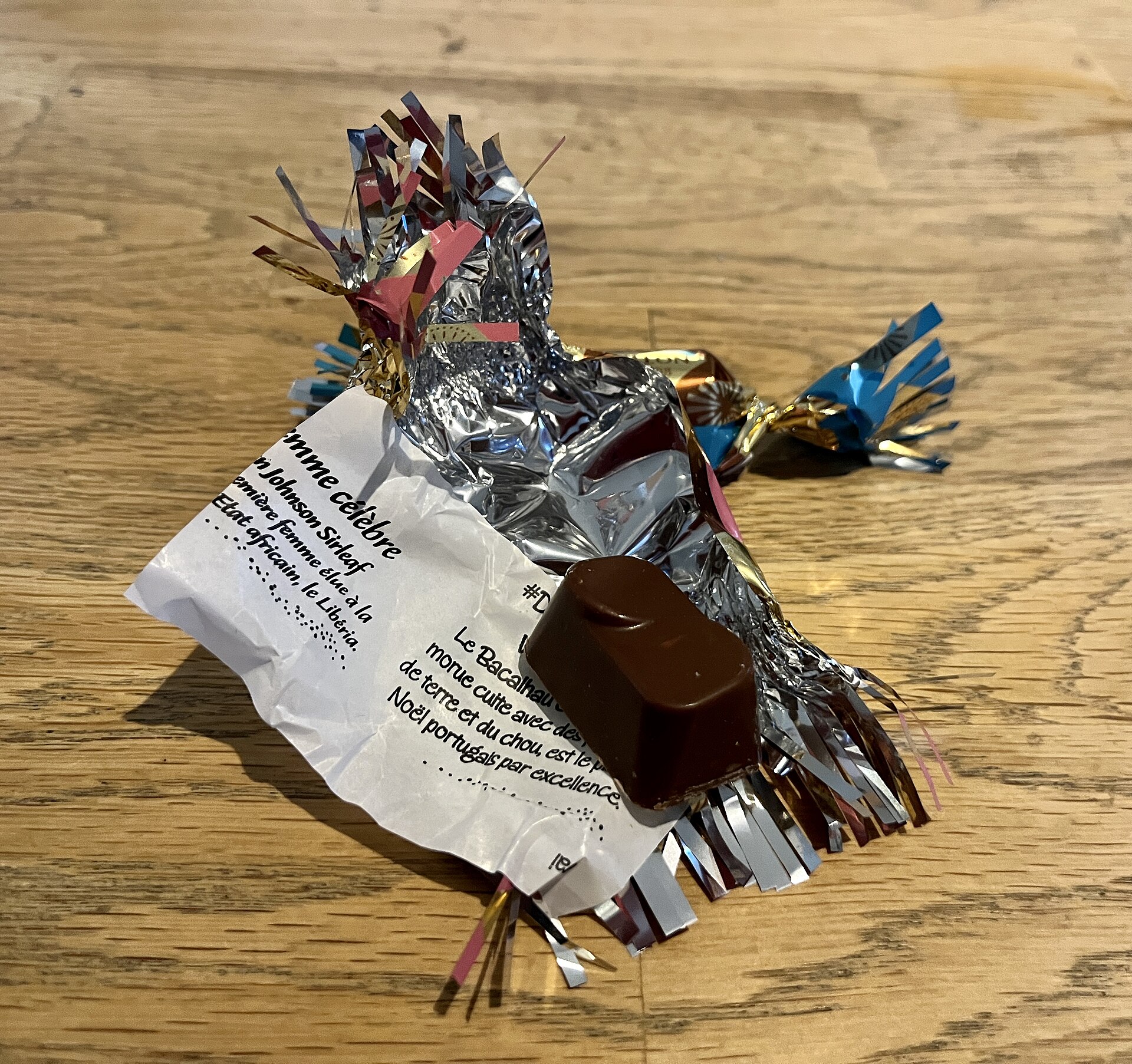
He asked for the artist. Inés came out in her pyjamas, suspicious, and he gave her the bag. Papillotes: those Christmas chocolates wrapped in shiny paper with a little slip of paper inside. He said they were from last year, that he was sorry, that he had nothing else, and that the witch looked a great deal like his sister. Inés asked if his sister was wicked. He said no, she was from Saint-Étienne, which was different. Claire had to go into the kitchen.
I offered him a coffee. He said no, he didn't want to intrude, and came in. He sat on the chair at my work table, the one nearest the door, and looked out at the courtyard with great attention, as if he'd never seen it from that angle. I suppose he hadn't.
The man who talks to himself
While I made the tinto, he asked what I did for a living. I told him I was a translator. He thought about it and said: "Ah. C'est donc ça."
It turns out his living room is directly above this table. And it turns out that when I translate, I read aloud. I always have, almost without noticing: when a sentence doesn't sound right I say it, repeat it, change it, say it again, sometimes in a lawyer's voice, sometimes in the voice of the author I'm translating. It's the only way I know of finding out whether a sentence in Spanish can breathe. Monsieur Delorme has been hearing this through the floor for years: a man talking to himself all day long, in a language he doesn't understand, saying the same words over and over with different intonations, like an actor who can't learn his part.
"J'ai cru que vous étiez un peu malade," he said, perfectly calm. He'd thought I was talking to someone who was no longer there. He didn't find it strange, because he does it too.
I didn't ask him who to. I poured him the tinto. He tasted it, his eyes went wide, and he said it was strong. I told him it was Colombian. It was from Carrefour. He drank the lot.
On his way out, already at the door, he turned and told me not to worry about the noise, that it wasn't noise. That there's been a lot of silence in the flat upstairs since 2019, and that at around eleven, when I start talking louder, he turns the radio down so he can hear better. That he doesn't understand a word. That he likes it anyway.
Today I went back to the logistics contract, which is up to page thirty-one. There's a clause on penalties for late delivery that cannot be made to look nice, whatever you do. I read it aloud three times, and the third time, without thinking, I read it a little more slowly, and a little louder, looking at the ceiling.
Keep reading
Chrysanthemums
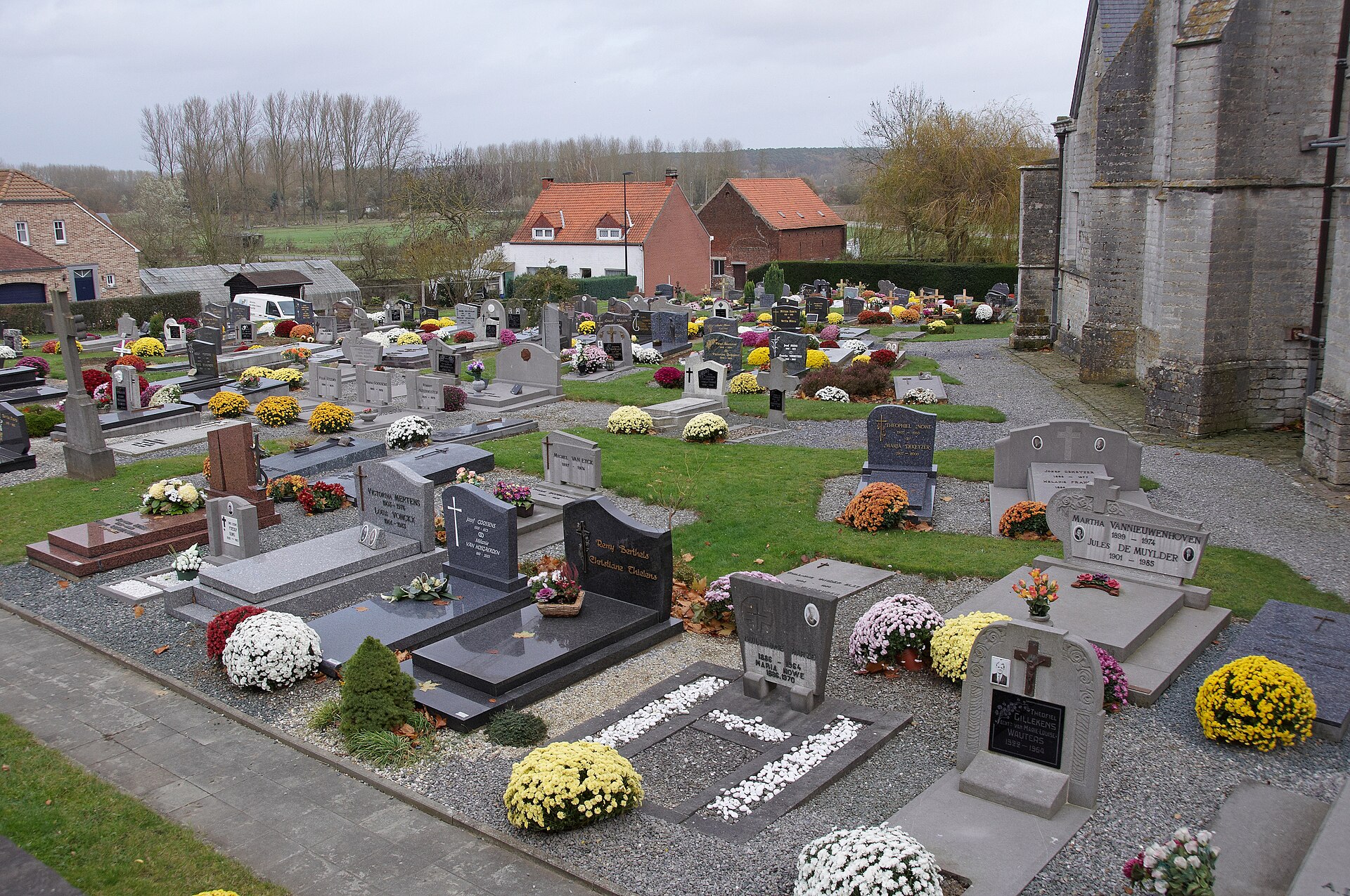
With the kids away in the Beaujolais, I went with Claire for the first time to clean her grandmother's grave before Toussaint, and thought about my father's plaque in Bogotá.

The house without them
Claire's parents took the kids for two nights to their house in the Beaujolais. Claire and I were left alone in the flat and didn't quite know what to do with the silence.

Parents' evening, in French
Tomás's teacher asked Claire and me to come in before the All Saints break. I understood every word, and still left the meeting not understanding what I had been told.